Ten, Nine, Eight… Nobody Brought the Extension Lead: Britain's Christmas Light Committees, Ranked
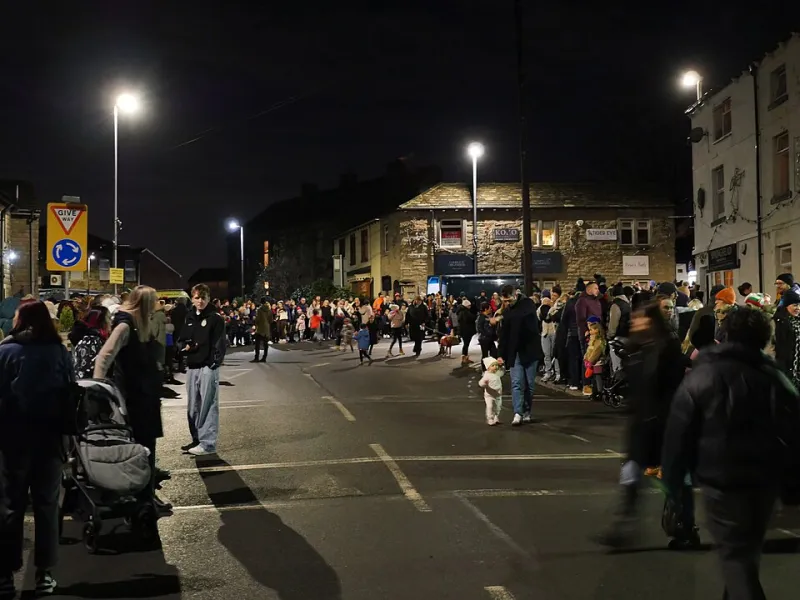
Photo: habiloid , CC BY-SA 2.0, via Wikimedia Commons
Every year, at about this point in November, a small group of British volunteers discovers that the Christmas lights they bought in a January sale do not have a plug that matches the socket on the side of the town hall. It is, reliably, the most suspenseful moment in the local civic calendar — more tense than the parish council by-election, more fraught than the summer fete rota.
The 2026 switch-on season is now cranking into life across the country, and we are here for all of it. Not to mock, you understand. Only to watch very closely, and then assign grades.
Britain's last great amateur production
There is no other event quite like the switch-on. It is a piece of theatre performed by people who have day jobs, on a stage made of scaffolding, in front of a crowd that expects pantomime and gets, roughly, forty minutes of pre-recorded music and a raffle. It is also genuinely lovely, and it is entirely held together by a WhatsApp group titled something like XMAS LIGHTS 2026 — READ THE PINNED MESSAGE.
The committee
Every switch-on committee contains, roughly:
- The Chair, who has a spreadsheet and a personal grudge against the previous chair
- The Treasurer, who has a biscuit tin, a bank account with two signatures, and the expression of a hostage
- The One With A Van
- The Bulb Expert, self-appointed, semi-mystical, usually correct
- The Dignitary Liaison, whose job is to prevent the mayor and the vicar from standing in the same puddle
- Three people who said they'd help in September and have not been seen since
The celebrity booking
This is where it always goes wrong. The committee establishes a budget — one year it was £400, one year it was 'exposure' — and approaches a celebrity. The definition of celebrity here is generous and the negotiation is short. What follows is either a local radio presenter, a soap actor who left in 2011, or a man who once appeared on a talent show and now has a podcast.
Occasionally the booking collapses two days before the event, and the committee performs the great British manoeuvre of quietly promoting someone else to 'local legend' status. The deputy mayor, in most towns, is already aware that this is his moment.
The bulb situation
By the evening of switch-on, several strands of lights will not be working. This is not a fault, it is a tradition. It creates what we are calling rogue bulb suspense: the moment when the countdown ends, the crowd cheers, and everyone simultaneously notices that the 'O' in the festive greeting has gone dark and it now reads something faintly rude in big letters above the precinct.
The committee's response follows the standard arc: denial, a ladder, a fuse box, a man being handed a torch, and finally a very calm decision to call it 'characterful'.
Our ranking criteria
We have graded on three things:
- Countdown-clock suspense — the length of build-up between 'and now…' and the actual illumination, plus whether anyone forgets to switch the clock on
- Tinsel audacity — the willingness to wrap something structurally unsound, such as a war memorial or a roundabout
- Deputy-mayor rain-speech index — the likelihood of an unscripted address delivered into a microphone that has stopped working
The ranking
Beccles — magnificent proportions, a proper crowd, and enough tinsel to worry the fire service. Countdown clock run with genuine ceremony. High baseline. A−
Ulverston — heavy on community ownership, light on professional rigging, and the better for it. The kind of switch-on where a brass band turns up without being asked. Suspense: substantial. B+
Oswestry — a town that takes its lights personally. Robust ceremony, good scaffolding, and a strong historical record of a rogue bulb addressed with dignity rather than panic. B+
Thirsk — charmingly proportionate. Low budget, high effort, and at least one strand of lights that has clearly been repaired by a man in a shed. B
Frome — every switch-on is theoretically accompanied by a lantern procession, which is lovely, but it does mean the actual lighting moment arrives after roughly nine minutes of people walking the long way round. B
Paisley — full municipal spectacle, mayoral presence, choirs, the works. Countdown: assured. Speech: scripted and therefore slightly less thrilling than the alternative. B
The anonymous town that cancelled in 2019 and has not been forgiven — inscribed on the wall of shame with a flourish. D. We will not be naming it. It knows what it did.
How to survive your own switch-on
Arrive twenty minutes late and stand near the back, where the sound is bad and the exits are good. Cheer for the leg of the countdown where the crowd goes quiet. And if a man in a hi-vis turns up with a roll of black tape and a look of purpose, get out of the way — he is the only person there who actually knows how electricity works, and he has about four minutes.
Get the timing wrong and the switch-on is a damp two-minute flicker before the crowd disperses to the chippy. Get it right and a high street becomes a place to be on a cold evening in November, which is not nothing. It's the cheapest pantomime Britain has, and it has a far better chance of a live bulb malfunction. Book your spot by the barrier, bring a flask, and mind the extension lead.