Curtain Up on Several Coats of Dulux: Britain’s Village Hall Backdrops, Assessed
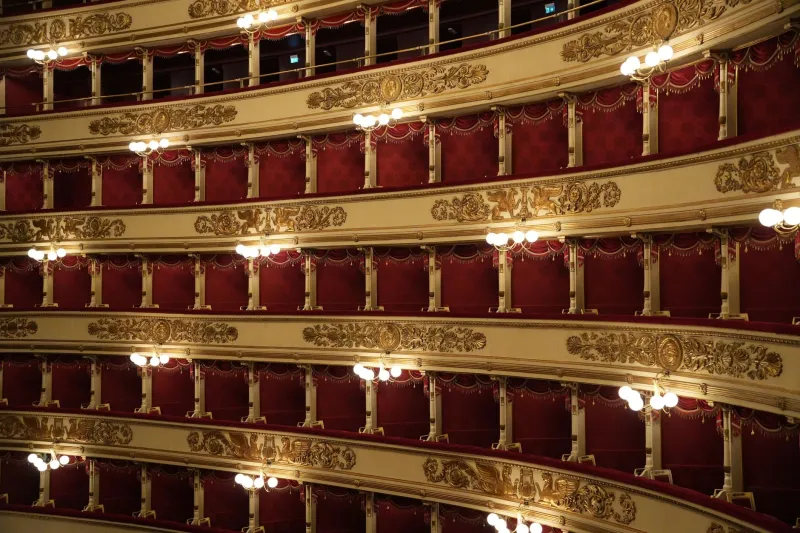
There is a particular smell to a village hall ten minutes before curtain-up: dust, Sanitaire floor polish and the faint whiff of emulsion that never quite dried in 1998. You take your seat on a plastic chair that has known the bottoms of four generations, and there, framed by the sticky velvet curtains, is the backdrop. Not a printed vinyl banner. Not a digital projection. A proper, hand-painted, slightly warped panorama of somewhere that may or may not exist, executed by a local enthusiast with more vision than perspective.
These are the true folk art of British amateur theatre. They are also, frequently, a hazard. A backdrop can make a mediocre production feel ambitious, or make a decent one look like it is being performed inside a fridge magnet. And with village hall committees forever eyeing the wall for the next quiz night, these painted worlds are always one AGM away from being overpainted in magnolia. So let us celebrate them while we can.
The grading system
To assess these masterpieces fairly, we use four measures.
Ambition — how much the artist attempted, regardless of whether it worked. A wonky lighthouse scores higher than a competent but timid hedge.
Paint layers — the Dulux Index. One coat suggests optimism; seven coats suggest a scene that has been revised through several committees and at least one schism.
Historical accuracy — does the castle have arrow slits in the right place, or has it been fitted with a conservatory? Does the harbour include a 1970s caravan? We are not snobs, but we do notice.
PCCL — Pantomime Cow Collision Likelihood. This measures the chance of a two-person cow, moving at speed in low light, making contact with the backdrop during a chase sequence. A flat wall scores low. A backdrop propped on two wobbly uprights and a prayer scores very high indeed.
The Harbour Scene: ambition 8, Dulux 4, accuracy 6, PCCL 7
The harbour is the dependable workhorse of the village hall stage. It says: we are by the sea, or we wish we were, and we have a painter who once did a watercolour course in 1994. You will see a crescent of quayside, three boats with inexplicable rigging, and a sky that transitions from stormy grey to a cheerful blue in a manner that suggests the artist lost confidence halfway through.
The boats are usually the giveaway. They sit on the water rather than in it, and their masts lean at angles that would alarm the RNLI. A gull is generally present, painted as a large white comma. If the production is serious, the harbour will be described as ‘atmospheric’. If it is a pantomime, someone will have stuck a real fishing net to it with Blu Tack, and by Act Two it will be hanging off one corner like a cobweb in a draught.
The harbour’s great strength is versatility. It can be Cornwall, it can be Whitby, it can be a fictional seaside town where the lead actor has to pretend to enjoy a pint of shandy. Its weakness is the PCCL: boats painted at floor level are an invitation for a cow to clip the quayside and send the whole thing wobbling. We have seen it happen. The audience gasped. The cow did not break character.
The Castle: ambition 9, Dulux 6, accuracy 4, PCCL 5
The castle backdrop is the ambitious one. It arrives when a society decides to stage something historical, or at least something with a sword in it. You get a crenellated tower, a portcullis that looks suspiciously like a garden trellis, and a sky full of cartoon clouds. The flag is always flying the wrong way.
Historical accuracy is where the castle really suffers. Arrow slits are placed at eye level. The drawbridge appears to open directly onto a grassy bank with no moat. On one memorable backdrop in a hall near Hexham, a small conservatory had been added to the side of the keep, presumably because the artist ran out of grey paint and had a lot of green left. It was, in its way, a vision of a more comfortable medieval Britain.
The Dulux Index tends to be high here because castles invite revision. A tower gets taller. A flag changes colour. Someone decides the scene needs a dragon, and a dragon is added with the confident brushwork of a person who has never seen a dragon. By the time the production opens, the backdrop has the texture of a relief map. It is magnificent. It is also heavy, which brings the PCCL down slightly: a well-secured castle backdrop is less likely to topple, even if the cow does clip it.
The Forest: ambition 7, Dulux 5, accuracy 3, PCCL 9
The forest backdrop is where things get strange. Trees are hard. Trees require a certain understanding of trunk-to-canopy ratios that many amateur painters do not possess. The result is a row of brown columns topped with green clouds, like a meteorological conference. The undergrowth is usually a smear of dark green that suggests either ferns or a swamp, depending on the lighting.
And then there is the willow. Every few years, a backdrop features a willow tree painted with such theatrical droop that it dominates the scene. It hangs over the action like a melancholy relative. It is never just a willow; it is a statement. The branches trail into the middle of the stage. The trunk has been given a face-like knot. In one production of The Wind in the Willows, the willow was so dramatic that Mole’s cheerful picnic looked like a hostage situation.
Forests score highest on the PCCL because they are often painted on lightweight flats that are moved between scenes. A pantomime cow, galloping through a wood, has a very good chance of catching a corner and bringing the entire ecosystem down. The audience loves it. The stage manager does not.
The Abstract Backdrop: ambition 10, Dulux 2, accuracy 0, PCCL 4
Occasionally, a hall abandons representation entirely. The backdrop becomes a swirl of colour, or a geometric pattern, or a single large circle that is meant to be the moon. These are the punk rock backdrops. They say: we have no budget and no time, but we have a projector and a tin of tester pots. They are often used for revues, cabarets and anything written by someone in the village who has ‘a bit of a way with words’.
We respect the abstract. It cannot be historically inaccurate because it is not trying to be history. Its Dulux Index is low because nobody dares touch it. Its PCCL is moderate: a cow can run past a swirl without incident, but a cow can also run into a swirl and emerge looking like it has been in a fight with a lava lamp. Both outcomes are acceptable.
Nominate your local masterpiece
Every village hall has one. The backdrop that has been there since before anyone can remember, painted by someone’s uncle, touched up by someone’s cousin, and now quietly peeling behind the Christmas fair. It might be a harbour. It might be a castle. It might be a willow tree with emotional issues.
Before the committee paints over it for the quiz night, tell us about it. Send us a photo, a rough location and your own grade. We are particularly keen to hear about any backdrop that has survived a pantomime cow, a fallen fairy light or an overenthusiastic sword fight. The faded rainbow of the village hall deserves a proper archive, and you are the archivists.
Curtain up.