Glass, Gables and Bus-Stop Grandeur: Britain’s Strangest Shelters
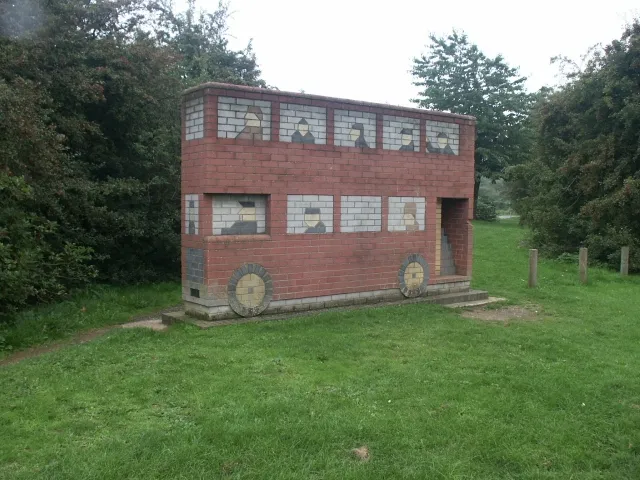
Photo: Katy Walters, CC BY-SA 2.0, via Wikimedia Commons
There are two kinds of British bus shelter. The first is a grim glass box with a timetable that has been licked by damp and a bench designed by someone who hates knees. The second is a work of folk architecture: a little building with gables, flower boxes, laminated notices and a sense of purpose far beyond keeping the rain off a pensioner called Brenda.
This is an ode to the second kind. Because while the rest of the world builds bus stops, Britain occasionally builds bus-stop-ish monuments — and then argues about them at parish council meetings for eleven years.
The Highland shelter with a stained-glass window
In the Scottish Highlands, weather is not a background condition; it is a character. So a bus shelter with a stained-glass window does not seem absurd. It seems sensible. The window might show a ferry, a hill, a sheep, or a abstract swirl that the local craft group insists is a heron. On a grey afternoon, the light comes through it in colours that make the waiting feel briefly ceremonial.
This is over-engineering in the best sense. Nobody needed stained glass to wait for the 14.32. But somebody needed the 14.32 to feel less like a punishment. The shelter becomes a tiny public living room, with a bench, a bin, a noticeboard and the unspoken rule that you do not hog the dry end.
The Norfolk shelter shaped like a beach hut
Norfolk has a long and distinguished relationship with the beach hut, so it was only a matter of time before the bus shelter got in on the act. The result is a striped, gabled little number that looks as if it should be holding a deckchair and a thermos rather than a timetable. It is cheerful. It is slightly ridiculous. It is exactly the kind of building that makes a village feel like a village rather than a postcode.
The locals are proud of it in the way that British people are proud of things that are difficult to justify on a spreadsheet. It has probably won a minor civic award. It has definitely been photographed by someone’s aunt. It may have a plaque. If it does not have a plaque, someone is campaigning for one.
Why Britain over-engineers the wait
A bus shelter is a tiny piece of civic infrastructure, which means it is also a tiny piece of civic anxiety. If the bus is late, the shelter must be blameless. If the rain is horizontal, the shelter must be heroic. If the village is small, the shelter must carry more symbolic weight than the parish church noticeboard.
So the shelter becomes a project. The Women’s Institute raises money for hanging baskets. A retired engineer fixes the roof. Someone’s nephew donates a bench in memory of someone’s uncle. The parish council debates the colour for three meetings and settles on a shade called ‘heritage sage’ that is almost identical to the previous shade. This is not inefficiency. This is local democracy in a waterproof hat.
A short field guide to shelter types
The Glass Vitrine: all angles and optimism, usually found near a new housing estate. Looks clean in photographs, freezing in February.
The Alpine Chalet: wooden, gabled, faintly Swiss. Makes you expect a hot chocolate and a ski lift, delivers a bus that is eight minutes late.
The Bus-Stop Bothy: stone walls, small window, a bench that could survive a small war. Found in places where the wind has opinions.
The Beach Hut: striped, cheerful, possibly with a name plaque. Suggests holidays, delivers a commute.
The Minimalist Nudge: a single pane of glass and a metal bar. Technically a shelter. Spiritually a threat.
The shelter as village noticeboard
Look closely at any good bus shelter and you will find a second life. There is the timetable, of course, but also the laminated notices: a lost cat, a yoga class, a choir looking for tenors, a warning about a road closure that ended in 2023. The shelter is a community noticeboard with a roof. It is where information is posted, read, ignored and eventually faded into a kind of municipal beige.
And then there is the bench. The bench is where the politics happens. Who sits where. Who cleans it. Who has been sitting there since 6.45am and has therefore earned the right to comment on everyone else’s gardening. The bus shelter is a waiting room, but it is also a stage.
What the shelters reveal
Britain’s strangest bus shelters reveal a nation that cannot resist making the ordinary slightly odd. We could have plain glass boxes. We have chosen stained glass, beach huts and gables. We have chosen benches with plaques and bins with lids that don’t quite fit. We have chosen to treat a wait for public transport as an opportunity for civic expression.
Is it over-engineered? Yes. Is it inefficient? Occasionally. Is it wonderful? Also yes. In 2026, when so much of life is designed for smoothness and speed, there is something deeply reassuring about a bus shelter that has been lovingly, unnecessarily, gloriously overthought. The bus may still be late. But at least the wait has a window.