Yew’ll Believe It: Grading Britain’s Topiary Beasts on Nerve, Neatness and Legs
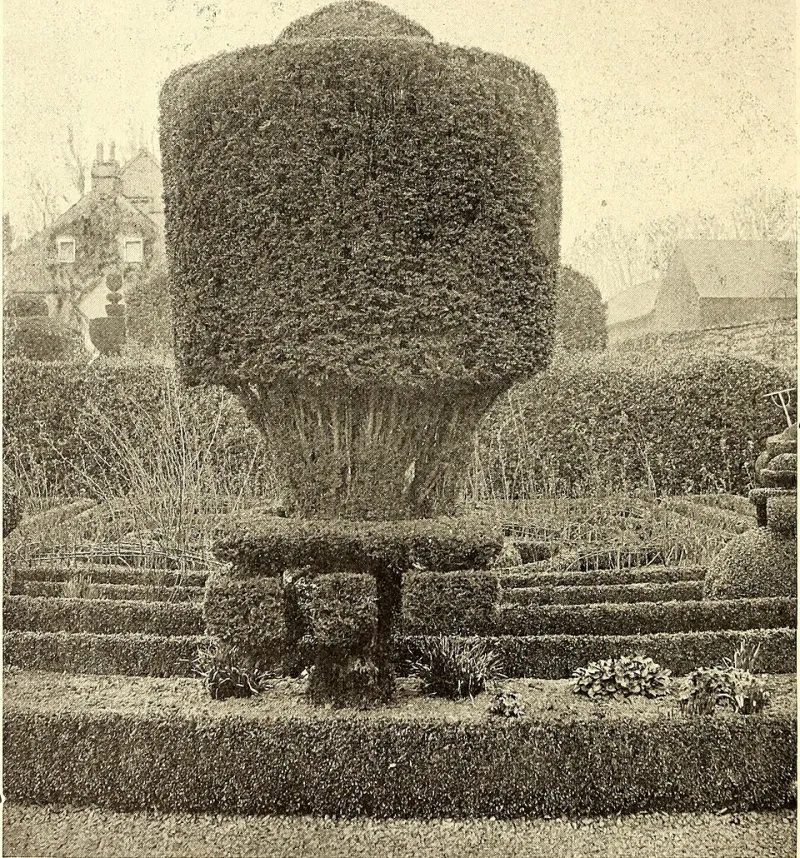
Photo: Internet Archive Book Images, No restrictions, via Wikimedia Commons
There is a moment, on a dull stretch of dual carriageway or a lane behind a garden centre, when you look up and think: that hedge is definitely looking back. Britain’s topiary tradition has moved beyond the modest cone and the well-behaved ball. We are now a nation of amateur animal sculptors, snipping dinosaurs, ducks and — in one memorable case — a teapot out of yew and box. Some are masterpieces. Some look like a shrub that has been frightened by a lawnmower. All deserve a day out.
Here, then, is a wholly unscientific tour of Britain’s topiary creatures, graded on ambition, leg-count accuracy, year-round neatness and the strength of the local myth that the person responsible ‘used to be a gardener for the Queen’. That last criterion is not about evidence. It is about delivery. A topiary giraffe with four legs and a vague neck is one thing; a topiary giraffe with six legs and a neighbour who says the owner once did the borders at Balmoral is quite another.
The Business-Park T-Rex: Ambition 9, Legs 2/10, Neatness 7, Royal Myth 4
Let us begin with the king. Somewhere near a business park — the sort of place where the signage is all grey and the sandwich van arrives at 11:40 sharp — sits a topiary Tyrannosaurus rex. It is huge. It is green. It has the unmistakable posture of a creature that has just remembered it left the oven on.
The ambition is undeniable: you do not accidentally carve a Mesozoic predator beside the visitor parking. The leg count is technically correct for a T-rex, which is to say two, but the legs themselves look less like limbs and more like two sturdy gateposts that have been told to relax. Neatness is good in summer, patchy in February, and the whole thing has the faint air of a dinosaur who has been asked to wait quietly while someone finds the keys.
The royal myth here is weak. Nobody at the business park claims the gardener worked for the Queen; they claim he ‘used to do something with lawns for the council’. Still, full marks for nerve. A T-rex in a hedge is not a statement about nature. It is a statement about the owner’s refusal to accept that a shrub should know its place.
The Village Duck That Became a Landmark: Ambition 5, Legs 2/2, Neatness 9, Royal Myth 8
Every so often, a topiary creature stops being a garden feature and becomes infrastructure. In one village — you know the sort: one shop, two benches, a noticeboard advertising a lost cat from 2023 — a hedge duck has achieved exactly that. It sits by a wall, rounded and serene, and people give directions using it. ‘Turn left at the duck.’ The duck does not mind. The duck is a bush.
Ambition is modest. A duck is not a T-rex. But the execution is superb: two legs, correctly placed, a bill that reads as a bill rather than a beak that has given up, and a body shape that suggests contentment rather than chaos. Neatness is high because ducks are forgiving; you can trim a duck badly and it still looks like a duck that has had a busy week.
The royal myth is strong. Local consensus holds that the person who trims it ‘used to be a gardener for the Queen, you know’. There is no proof. There is also no proof against it. The duck says nothing. The duck is playing a long game.
The Hedge Teapot Visible Only From the Right Bus: Ambition 7, Legs 0/0, Neatness 6, Royal Myth 9
This is the connoisseur’s topiary. A teapot, carved from hedge, positioned so that it can only be properly seen from the top deck of the number 14 as it rounds a bend at roughly 3pm. From the pavement it looks like a bush with a handle. From the bus it looks like a teapot. This is either genius or a cry for help, and the difference depends entirely on which side of the window you are sitting.
Leg-count accuracy is irrelevant, which is its own kind of liberation. There are no legs. There is a spout. There is a lid. There is a handle that has been allowed to go a bit rogue, like a handle that knows it is the weakest link and has decided to lean into it.
Neatness is mid. Teapots require precision, and precision in yew is a seasonal commitment. By August it is charming. By March it is a bush that has been told to imagine a teapot. But the royal myth is outstanding. The story goes that the owner ‘did the tea tent at a garden party the Queen attended once’, which is not the same as being a gardener for the Queen, but has been polished by repetition into something close enough. You have to respect the craft.
The Six-Legged Dragon of the Recreation Ground: Ambition 10, Legs 6/4, Neatness 4, Royal Myth 3
Then there is the dragon. There is always a dragon. This one lives behind a recreation ground, next to a bench with a plaque that says ‘Please Respect the Grass’. It has six legs. Dragons, as any schoolchild will tell you, have four. The extra two appear to be an attempt at wings that gave up halfway through and decided to be legs instead.
Ambition is off the scale. Leg-count accuracy is a disaster. Neatness is variable, because a six-legged dragon is a lot of hedge to keep on top of, and by late summer it has the slightly shaggy look of a creature that has been on holiday. The royal myth is weak — the owner is widely believed to have ‘done a bit of landscaping for the parish council’ — but the dragon does not need myth. The dragon has presence. The dragon has six legs. The dragon is trying its best.
The Verdict: Britain’s Hedges Are Winning
What unites these creatures is not skill. It is a refusal to accept that a hedge should simply be a hedge. A topiary T-rex, a landmark duck, a bus-only teapot and a six-legged dragon are all, in their own way, acts of civic optimism. They say: someone looked at a shrub and thought, ‘That could be a dinosaur.’ They say: someone stood back with a pair of shears and thought, ‘Close enough.’ They say: someone’s neighbour has been telling people they used to work for the Queen, and nobody has bothered to check.
So next time you pass a hedge that looks suspiciously like an animal, do not just walk on. Stop. Grade it. Count the legs. Ask about the Queen. Britain’s topiary menagerie is out there, quietly growing, waiting for the right bus.