One-Third Scale, Full-Size Anxiety: Britain's Model Villages, Graded on Tiny Bus Stops and Civic Drama
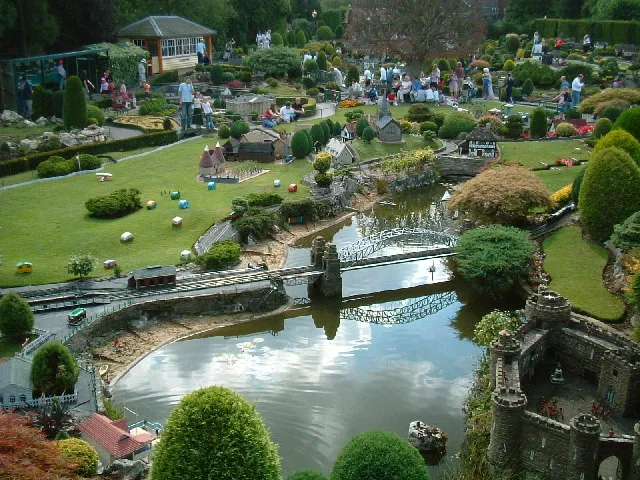
Photo: Ray Stanton, CC BY-SA 2.0, via Wikimedia Commons
There is a particular kind of British happiness that can only be achieved by standing over a village you are not allowed to touch. Model villages offer exactly this: a country in miniature where the church spire is straight, the war memorial is tidy, and the bin lorry has never once been three weeks late. Everything is one-twelfth of the size and roughly one-twelfth of the stress.
But look closer and the civic drama is all there, just compressed. A miniature zebra crossing implies a miniature argument about whether it was needed. A tiny bus shelter with nobody inside it speaks to a timetable printed in hope. And somewhere in every model village is a small, immaculate high street that has never known a charity shop, a vape emporium or a planning appeal — which is either utopian or deeply sinister, depending on how much time you spend on your local Facebook group.
How we marked them
Five categories, because five is a nice number and we once worked in local government:
- Craftsmanship — mortar, thatch and whether the terraces have proper chimney pots
- Miniature signage — tiny shop signs, minuscule road markings and any legible bus timetable
- Tiny transport — trains, milk floats, funiculars and other conveyances small enough to lose under a sofa
- Civic drama — implied planning rows, permanent traffic jams, miniature funerals, the sense that something is about to happen
- Melancholy — the ache of seeing a perfect high street at a scale where nobody can actually live
Bekonscot: the original and best-behaved
The oldest of the lot, and the one against which all others are quietly measured. Bekonscot has been keeping a 1930s England in aspic since 1929, which means its residents have now endured nearly a century of standing very still in a very tidy garden.
What it does brilliantly is bureaucracy at scale. The railways run to a timetable. The lake has boats. The cricket match is permanently mid-over, frozen in a moment of gentle tension that no model has ever resolved. There is an almost indecent number of chimney pots, each one of which somebody has cared about.
Best feature: the sheer number of trains, which gives the whole place the air of a town whose entire economy is rail infrastructure.
Worst feature: you will spend forty minutes trying to work out whether the little people are supposed to be motionless, and then you will feel a bit odd about it.
Grades: Craftsmanship A · Signage A− · Tiny transport A+ · Civic drama B (everyone is far too well behaved) · Melancholy A−
Bourton-on-the-Water: the village that contains itself
There is something profoundly British about building a scale model of your own village and then charging people to look at it. Bourton's version has been doing this since the 1930s, at roughly one-ninth scale, and the result is a pleasing hall of mirrors: a model of a model village, tucked inside the real thing, which is itself mostly gift shops selling things about the model.
Technically it is superb — the little River Windrush is accurately damp, the low bridges are accurately low. As a piece of civic self-regard it is unmatched. As a piece of municipal drama it is a bit thin, because everyone in it appears to be on holiday.
Grades: Craftsmanship A− · Signage B+ · Tiny transport C (the river is doing most of the work) · Civic drama C+ · Melancholy B
Babbacombe: the ambitious one
If Bourton is a postcard, Babbacombe is a planning department. There is simply more of everything: more buildings, more vehicles, more of that slightly hectic energy you get from a town that has decided to be a tourist destination and is going to see it through.
This is the model village most likely to have a miniature traffic jam, a miniature roadworks and a miniature argument about the miniature roadworks. The signage is excellent, the little vehicles are absurdly well observed, and the whole thing has the air of a place where a tiny councillor is about to propose a tiny by-pass.
Grades: Craftsmanship A− · Signage A · Tiny transport A · Civic drama A+ · Melancholy B−
Pendon: for the purists
Not a village so much as a study of the Vale of White Horse as it might have been in the 1930s, built by people who take accuracy seriously enough to have opinions about bucket shanks. The signage is exemplary. The rolling stock is beyond reproach. There is very little whimsy, which is either a strength or a disappointment depending on whether you brought a child.
Grades: Craftsmanship A+ · Signage A · Tiny transport A+ · Civic drama C · Melancholy A
Wimborne and Godshill: the quiet achievers
Both do the thing model villages do best: the low, honest, unmistakably-English vernacular of thatch and flint and narrow lanes, executed at a scale where the hedges look magnificent. Godshill's gardens are the star; Wimborne's tight street grid is the star. Neither will give you a tiny traffic jam, but both will make you want to move into a building you cannot fit inside.
Grades: Craftsmanship B+ both · Signage B · Tiny transport C+ · Civic drama C+ · Melancholy B+
Is it worth the entry fee in 2026?
Yes, generally, and not for the reason you think. You are not paying to be charmed. You are paying to look at a town where nothing has gone wrong, and to feel a strange pang about it. The model village is the British civic imagination rendered harmless: a high street with no boarded windows, a bus stop with a bus, a church with a congregation of painted people who never complain about the roof fund.
It is also, if we are honest, a very cheap way to feel enormous. Go for an afternoon, stand over a county, and enjoy the only time in your life you will ever have a genuinely proportionate sense of your own importance.